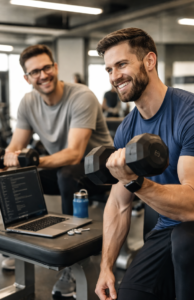
IT professionals live in a world that rewards mental output, rapid adaptation, and long hours of focused screen time. The work is demanding in a way that is not always visible from the outside. Deadlines stack up, meetings run long, production issues break at the worst possible time, and the body often pays the price while the mind keeps pushing forward. Add GLP-1 medication into the picture, and the conversation around health becomes even more important.
For many busy people in tech, GLP-1 medications can be a meaningful tool for weight loss and better metabolic health. That part gets attention fast. What often gets overlooked is what happens to muscle, strength, energy, posture, and physical resilience during the process. Weight loss alone is not the full picture. The goal is not simply to become lighter. The goal is to become healthier, stronger, and more capable in daily life and long-term career performance.
That is exactly why strength training on GLP matters so much for busy IT professionals. When your career depends on sustained focus, mental endurance, and the ability to show up at a high level day after day, protecting lean muscle is not optional. It is part of protecting your performance, your confidence, and your future health.
Why IT Professionals Need a Different Health Conversation
The tech world moves quickly, and the body does not always get treated like it matters until something starts to hurt. Long sessions at a desk, poor sleep habits during crunch periods, limited movement, and stress-driven eating can quietly chip away at physical health over time. For many IT professionals, the workday is built around intense concentration but very little physical demand. That imbalance creates a problem.
The industry itself is also changing fast. The pace of AI adoption, workforce transformation, and changing expectations around digital productivity are shaping how people work. Microsoft’s Work Trend Index has highlighted the pressure modern knowledge workers face, while Reuters reporting on OpenAI’s workforce expansion and Reuters coverage of HSBC naming its first Chief AI Officer show how quickly AI-centered business change is reshaping professional life.
For IT professionals, that means one thing very clearly: you do not just need to keep your skills current. You need your body to keep up with the demands of a high-performance career. Physical weakness, low energy, recurring pain, and reduced stamina make everything harder. Strength training helps build a stronger base so you can meet a mentally demanding job with a body that supports you instead of holding you back.
What GLP-1 Changes in the Body
GLP-1 medications can support appetite control and weight loss, which can be a huge win for people who have struggled for years to get healthier. But rapid or significant weight loss can come with a hidden tradeoff if it is not managed well. The scale may move, but not every pound lost is body fat. Some of it can come from lean muscle.
That is the part more people need to understand. Muscle is not just for appearance. Muscle affects metabolism, strength, stability, mobility, daily function, and how strong you feel during work and life. Wikipedia’s page on strength training gives a simple overview of how resistance training supports muscular adaptation, but the real-world takeaway is even more practical: if you lose too much muscle while losing weight, you may end up smaller without actually becoming stronger or more resilient.
That matters even more for busy professionals who already spend much of the day sitting. If your job naturally reduces movement, you cannot afford to let muscle mass drift downward unchecked. Strength training becomes a protective strategy. It helps tell your body that muscle is still needed, still valuable, and still part of the plan.
Why Muscle Matters More Than Most People Realize
Many people start a health journey focused almost entirely on body weight. That is understandable, but incomplete. Muscle affects how you move, how you feel, and how well you tolerate the physical demands of daily life. It also plays a role in maintaining better posture, reducing the stress of long desk hours, and supporting healthier aging.
For IT professionals, muscle matters because work is often repetitive and static. Hours of coding, network monitoring, security review, troubleshooting, system design, or project management can create chronic tension in the neck, shoulders, back, and hips. Without a stronger musculoskeletal foundation, those stress patterns build up over time.
Strength training helps counter that. It develops the posterior chain, reinforces core stability, improves shoulder integrity, and supports better movement quality overall. A stronger body often means fewer aches after long workdays, better tolerance for travel or on-call disruption, and more physical confidence outside the office.
It also creates a strong contrast to the passive nature of many tech jobs. When your day is full of reaction, sitting, and screen-based decision-making, strength training gives you something physical, measurable, and empowering. You lift more. You move better. You feel more capable. That matters.
The Link Between Physical Strength and Career Performance
There is a tendency to separate fitness from professional life, but that split is not as real as people think. Your body influences your work whether you acknowledge it or not. Better strength can improve posture at the desk, reduce fatigue, and support more stable energy through the day. It can also help with confidence, discipline, and stress management.
That becomes especially relevant in a field where constant upskilling is expected. The cybersecurity world, for example, continues to grow in complexity, and NIST’s NICE Framework Resource Center reflects just how structured and demanding technical career pathways have become. At the same time, broader productivity expectations are shifting. Reuters reporting on AI and euro area productivity underscores how strongly business leaders are betting on more output from technology-enabled teams.
That kind of environment can become exhausting if your physical foundation is weak. Strength training does not replace skill, talent, or strategy. It supports them. A stronger body can help you sustain sharper work over time because you are not constantly fighting low energy, soreness, poor posture, or the compounding effects of inactivity.
Why Strength Training Is Especially Important While on GLP-1
GLP-1 can be part of a smart health plan, but it should not become a shortcut that causes you to neglect the deeper work of building a stronger body. In fact, being on GLP-1 makes resistance training more important, not less.
When calories drop and body weight decreases, the body needs a reason to preserve muscle. Strength training provides that reason. It tells the body that lean tissue is useful and should be maintained. Without that stimulus, there is a greater risk that weight loss becomes too passive and too dependent on eating less alone.
For busy IT professionals, this is powerful because strength training gives structure to a process that can otherwise feel vague. It shifts the goal from simply “losing weight” to improving body composition, maintaining function, and staying strong while health improves. That is a much better long-term strategy.
It also helps protect against the flat, depleted feeling some people experience when they lose weight without doing enough resistance work. Looking smaller is not the same as feeling strong. Strength training helps close that gap.
What This Looks Like in a Busy Tech Schedule
The good news is that strength training does not have to take over your life to make a real impact. Many IT professionals avoid it because they imagine long gym sessions, complicated splits, or a level of intensity that feels unrealistic with work demands. That is not necessary.
A practical plan can be simple and sustainable. Two to four focused sessions each week can go a long way when the training is consistent. Compound movements, progressive overload, and good recovery habits matter more than chasing a perfect routine. The goal is not to train like a bodybuilder. The goal is to preserve and build useful strength while managing work, family, and life.
That might mean short morning sessions before logging on. It might mean lunch-break workouts. It might mean a few well-structured evening sessions with an emphasis on major movement patterns like squats, hinges, pushes, pulls, and loaded carries. The exact format can vary, but the principle stays the same: make strength part of the plan, not an afterthought.
This is also where many professionals benefit from guidance. When the schedule is full and decision fatigue is real, having a clear training structure saves energy and increases follow-through.
Strength, Confidence, and Long-Term Health
One of the biggest mistakes people make is treating health like a temporary project. Busy professionals often go all in for a short season, lose momentum, and then start over later. Strength training encourages a different mindset. It builds something. It creates momentum that can continue long after the initial weight-loss phase.
That matters for confidence too. In fast-changing technical fields, it is easy to feel like everything is in motion. New tools, new threats, new systems, new expectations. Strength training offers something grounding. It gives you a repeatable process that proves progress is possible through consistency.
It also supports aging well. A successful career in IT can span decades. The better your physical foundation now, the better your odds of maintaining energy, movement quality, and independence later. That is not vanity. That is wisdom.
Conclusion
Busy IT professionals are used to optimizing systems, solving problems, and thinking ahead. Health deserves that same level of intentionality. GLP-1 may help move the scale, but strength training helps protect what truly matters during the journey: muscle, performance, resilience, posture, confidence, and long-term function.
In a profession shaped by long hours, rising cognitive demands, and rapid industry change, building physical strength is not a side issue. It is part of staying effective, capable, and well. The smartest approach is not just losing weight. It is becoming stronger while you do it.
For IT professionals using GLP-1, strength training is not extra. It is essential.